

Flax Field Management
Weed Control
Weeds can be a serious problem in flax if left uncontrolled. Because flax does not shade the ground as much as cereal grains, weeds have an excellent chance to develop. Some weeds like wild buckwheat and red root pigweed are luxury users of nitrogen and will rob the flax crop of needed soil nutrients. Weeds not only compete with the growing flax crops to reduce yields, but also cause losses from dockage in seed shipments. Dockage amounts to thousands of tonnes annually and is charged directly against marketing costs.

Benefits of Early Treatment
Early removal of weeds is necessary to minimize crop losses caused by weed competition. Weeds in the seedling stage are more easily controlled by herbicides than at any other growth stage, and early treatment usually decreases the risk of injury to the flax crop. Risk of injury is also reduced by using correct water volumes, usually 110 l/ha (10 gal./ac.). The performance of many herbicides can also be affected by soil moisture conditions, air and soil temperatures, and other environmental factors.

Registered Herbicides
Many herbicides are available for the control of weeds in flax. Herbicides approved for flax are not necessarily approved for solin. As of 2001, only a limited number of herbicides are registered for use on solin. Additional herbicides are currently being evaluated for possible future registration. Contact your local agricultural representative or chemical company agent for information.
Herbicide Application Periods
Weed Resistance to Herbicides
When choosing a product for weed control, records from previous years must be checked to ensure that the same herbicide (or members of the same herbicide group) is not used year after year on the same field. Frequent use of a herbicide group may lead to the development of resistance to that group of herbicides by a weed species.
Control of Volunteer Flax in Field Crops
Flax is not a strong competitor, so volunteer flax does not usually result in yield losses in competitive crops like cereals and canola. However, it can cause considerable difficulty at harvest time because it can remain green long after the crop is mature. This interferes with harvesting and can cause grain storage problems.
There is no herbicide that will provide sufficient control, or even suppression, of volunteer flax in broadleaf crops. However, quinclorac herbicide provides excellent control of volunteer flax in wheat. Quinclorac provides control of cleavers and a new mode of action for green foxtail control. Products or mixtures that contain dichlorprop (see provincial weed control guide for recommended product brands) will provide some suppression of volunteer flax in cereal crops. Use the maximum recommended rates. Products that include 2,4-D LV ester will have slightly more effect on the flax than 2,4-D amine or MCPA.
Because of the poor level of control likely to be achieved with herbicides, cultural practices are important in minimizing problems caused by volunteer flax. A competitive cereal crop managed for maximum competitiveness (early, shallow seeding; adequate, banded fertilizer; maximum seeding rate for the area) and treated with one of the herbicides mentioned above, should maximize the level of suppression.
Herbicide Listings
Weed control recommendations for flax are published annually by provincial departments of agriculture. For these publications and for the latest information and specific recommendations for your area, consult your local agricultural representative or weed supervisor.
Always read and follow label instructions carefully when using herbicides.
Pest Control
Flax may be infested from the time of emergence to maturity by various insect pests. To keep damage low, fields should be examined regularly, and controls applied when infestations reach the economic threshold. The following species are potentially damaging but often occur in too low a number to cause economic loss.
Pests of Flax Only
Flax bollworm
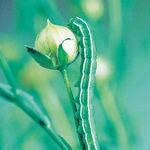
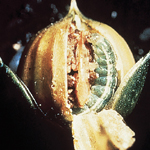
Flax bollworm, Heliothis ononis (Denis & Schiffermiller), is a climbing cutworm. Flax is the only crop it attacks. The moths deposit their eggs in the open flowers, and the young larvae eat the developing seed within the boll.
The older green and white striped worms leave the boll and complete development by feeding on other bolls from the outside. Economic infestations of this pest have been limited so far to west central Saskatchewan.
Pests of Flax and Other Crops

Grasshoppers
Grasshoppers are a hazard to flax. Young grasshoppers may attack young plants and cause damage. However, more damage is done to the crop before harvest by the older, larger grasshoppers. They can quickly cause large numbers of bolls to drop by chewing through the more succulent portions of the stem below the bolls.
Cutworms
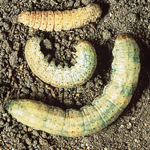
Two subterranean species of cutworms, the redbacked, Euxoa ochrogaster (Guen.), the pale western, Agrotis orthogonia (Morr.), and the early cutworm, Euxoa tristicula, attack flax.
The adult moths of these species lay eggs on the soil surface in weedy summerfallow fields during late summer. These eggs overwinter and the young larvae feed on flax seedlings in the spring. Cutworms usually remain below ground, cut off the young plants near the soil surface and draw them down where they are eaten. An average population of 12 redbacked cutworms/m2 (10/yd.2) can cause a 10% reduction in the yield of flax, and control should be considered.
Army Cutworm
Larvae of the army cutworm, Chorizagrotis auxiliaris (Grote), damage flax and many other crops by feeding on foliage in the spring, and to a lesser degree, in the fall. It is an important pest in southern Alberta and, to a lesser extent, in southern Saskatchewan. Populations of 10 or more larvae/m2 (9/yd.2) can cause significant damage.
Bertha Armyworm
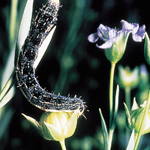
The bertha armyworm, Mamestra configurata (Walker), was a regular pest of flax before canola and mustard were grown on the Prairies. However, since the widespread introduction of the Brassica crops, the bertha armyworm rarely causes economic damage to weed-free flax fields. If bertha-armyworm-infested canola fields are swathed and green flax fields are nearby, the flax can then suffer significant damage from invading larvae. When abundant, bertha armyworms cause serious damage by chewing through the stems below the bolls causing them to drop to the ground. Young bertha larvae are green but larger larvae are usually velvet-black.
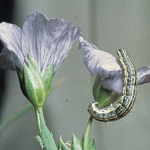
Beet Webworm
The beet webworm, Loxostege sticticalis (Linnaeus), is a slim, active, dark-green caterpillar which eats leaves, flowers and patches of bark from flax stems and branches. Localized areas can suffer severe damage. Determine if a significant number of bolls are being damaged before applying control.
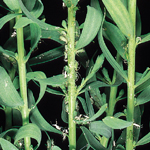
Aphid
One species of aphid, Macrosiphum euphorbiae (Thomas), commonly occurs in flax and can significantly reduce yields. Aphids fly into fields early in July, and reach peak densities in late July or early August. This pest uses its mouthparts to pierce and extract sap from stems and leaves. If aphid densities exceed three per plant when the crop is in full bloom, or eight per plant at the green boll stage, insecticidal control is cost effective. At least 25 plants in different parts of the field should be checked for aphids to determine if the economic thresholds are exceeded. If no action is taken when aphids exceed the thresholds, 5-25% or more of the yield may be lost.
Aster Leafhopper/Tarnished Plant Bug
The aster leafhopper, Macrosteles quadrilineatus (Fbs.), and the tarnished plant bug, Lygus lineolaris (Palisot de Beauvois), can also damage flax. These insects, like aphids, feed by sucking juices from the flax plants. Leafhoppers can carry aster yellows mycoplasm and also crinkle virus, and can infect the plants with these diseases while feeding. Tarnished plant bugs damage flax by feeding on the growing tips, which become distorted and die back. The damage from these insects is most serious on late-seeded crops.
Minor Pests of Flax
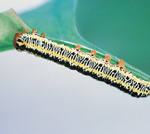
Zebra Caterpillar
The zebra caterpillar, Ceramica picta (Harr.), is another species which feeds on flax as well as many other crop plants. This is not normally a significant pest.
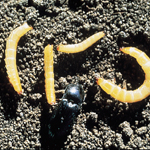
Wireworms
Wireworms, although often serious pests of cereal grains in the seedling stage, seldom damage flax.
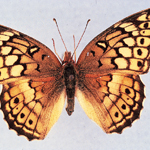
Variegated Fritillary
The adults and larvae of the variegated fritillary, Euptoieta claudia (Cram.), have been recorded on flax. However, this insect is usually not sufficiently abundant to cause economic damage.
Climbing Cutworm
A climbing cutworm, Polia lilacina (Harv.) has been widely distributed in flax fields in Saskatchewan and Alberta but apparently has not caused significant damage.
Chemical Control of Insects
Current recommendations for chemical control of insects of field crops are published annually by most provinces. For more information on insects and their damage, and for up-to-date information on control, consult district agriculturists, agricultural representatives or provincial entomologists.
Labels on pesticide containers also provide essential information on application procedures and pesticide safety, and should be followed closely.
Disease Control
Historically, wilt and rust have been the diseases that posed a threat to flax production in Western Canada. Recently, the incidence of pasmo and powdery mildew has been widespread, particularly in Manitoba. They have caused localized disease epidemics. Maintaining the resistance to rust and wilt continue as objectives in developing new varieties. Breeding for resistance to pasmo and powdery mildew is also occurring.
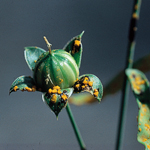
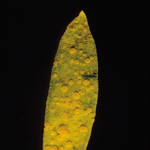
Rust
Rust is potentially the most dangerous disease affecting flax. It is a constant threat to flax production because it can survive locally and has the ability to produce new races that attack hitherto resistant varieties.
The causal organism is Melampsora lini, a fungus that overwinters by means of teliospores on flax debris. Early infections may completely defoliate flax plants and reduce the seed yield and fiber quality. Flax rust completes its life cycle on the flax plant, unlike many other rusts that require an alternate host.
Symptoms:
Rust is readily recognized by the presence of bright orange and powdery pustules, also called uredia. Rust pustules develop on leaves, stems and bolls but mostly on the underside of the leaves. The pustules produce numerous urediospores which are airborne and cause new cycles of infections during the season. Spread and infections are favoured by high humidity during cool nights, warmer day temperatures, and vigorous plant growth. As the season progresses, the orange pustules turn black and produce overwintering teliospores. The black pustules are most common on stems.
Control:
Complete control is achieved by the use of rust-resistant varieties. All registered varieties are immune to local races of rust. Planting susceptible varieties may not only result in serious yield loss, but also affords the fungus a chance to produce new races that attack resistant varieties. Additional safeguards include: destroying the plant debris, using certified and disease-free seed of a recommended variety, crop rotation, and planting the new flax crop in a field distant from that of the previous year.
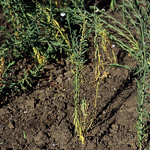
Fusarium Wilt
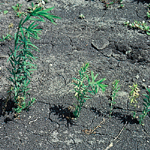
Flax wilt or Fusarium wilt is caused by the seedborne and soilborne fungus Fusarium oxysporum f.sp lini. The fungus invades plants through the roots, and continues growth inside the water-conducting tissue. This interferes with water uptake, and warm weather therefore aggravates the disease. Recommended varieties are resistant/moderately resistant.
Symptoms:
Seedlings may be killed shortly after emergence while delayed infections cause yellowing and wilting of leaves, followed by browning and death of the plant. Roots of dead plants turn ashy grey. The tops of wilted plants often turn downward, and form a “shepherd’s crook”. Affected plants occur more commonly in patches but may also be scattered throughout the field. The fungus persists in the soil, while the mycelia and spores survive for many years in debris of flax and other organic tissue. Wind-blown and run-off soil may spread the fungus from one field to another.
Control:
The most important control measure is the use of available resistant/moderately resistant varieties. Crop rotation of at least three years between flax crops maintains low levels of inoculum in the soil.
Pasmo
The causal organism of this disease is Septoria linicola, a fungus that attacks above-ground parts of flax and overwinters in the soil on infected flax stubble. Flax is most susceptible to pasmo in the ripening stage. Epidemics, however, can occur early in the season when favourable, moist conditions prevail. Pasmo can cause defoliation, premature ripening and can weaken the infected pedicels resulting in heavy boll-drop by rain and wind. Depending on the earliness and severity of the infection, pasmo reduces the yield as well as the quality of seed and fibre. Most commercial varieties lack resistance to this fungus.
Symptoms:
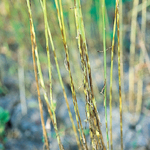
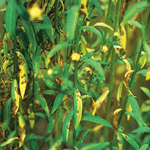
Pasmo is characterized by circular and brown lesions on the leaves and by brown to black infected bands that alternate with green and healthy bands on the stem.
Infected flax tissue is characterized by tiny black pycnidia which are the fruiting bodies of the fungus. The debris carries numerous pycnidia which overwinter and produce masses of spores that cause the initial infections on leaves and stems. Spores are dispersed by rain and wind. High moisture and warm temperatures favour the disease. Lodging favours the development of pasmo, because of increased humidity within the crop canopy, and results in patches of dead plants completely covered with the fungus.
Control:
The best control is achieved by early seeding at the recommended rates to avoid high moisture conditions in the fall, using clean seed, treating seed with a fungicide, controlling weeds, and following a rotation of at least three years between flax crops.
Stem Break and Browning
Stem break and browning are phases of a disease caused by the seedborne and soilborne fungus Aureobasidium pullulans var. lini, also called Polyspora lini. This disease is of minor importance in Western Canada, however, some damage may occur in the Parkland regions of Saskatchewan and Alberta in some years.
Symptoms:
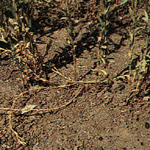
Stem break is the first conspicuous disease symptom. Development of a canker at the stem base weakens the plant, and the stem may break at this point when the plants are still young, or at a later stage. Plants may remain alive after stem breakage, but any seed produced may still be lost in harvesting. Initial infections in spring may start from spores produced on diseased stubble, and are spread by wind and rain. Infections may start during seedling emergence when seedcoats of diseased seed are lifted above the ground, and the fungus produces the first cycle of spores of the season.
The browning phase is initiated by infections on the upper part of the stem that appear as oval or elongated brown spots, often surrounded by narrow, purplish margins. The spots may coalesce, and leaves and stem turn brown. Patches of heavily infected plants appear brown, giving the disease the name of browning. The fungus may penetrate the bolls as well as the seeds, or may produce spores on the seed surface. However, affected seeds may remain viable.
Control:
Use of clean seed produced by healthy plants is the most important control measure. Fungicidal seed treatment controls surface-borne inoculum, but is unlikely to be effective against inoculum borne inside the seed. Rotating crops and planting flax in a field distant from that of the previous year reduces spread of infection from diseased stubble.
Seedling Blight and Root Rot
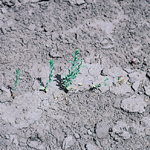
In spite of seed treatment, seedling blight and root rot can develop, leading to reductions in yield. Seedling blight and root rot may be due to soilborne fungi such as species of Fusarium, Pythium and Rhizoctonia. However, Rhizoctonia solani is the principal causal agent and can be particularly destructive in soils that are loose, warm and moist. R. solani survives as a composite of strains that differ in host range and pathogenicity. Strains attacking sugar beets and legumes such as alfalfa and field peas also attack flax. Yellow-seeded varieties (e.g. solin varieties) are more prone to cracking which renders them more susceptible to seedling blight and root rot than brown-seeded varieties.
Symptoms:
Blighted seedlings turn yellow, wilt and die. Infected seedlings may occur singly or in patches. Seedling blight may be inconspicuous, and gaps in the row may be the principal sign of disease occurrence. Roots of recently affected plants show red to brown lesions, and may later turn dark and shrivel. Diseased plants are often difficult to distinguish from those killed by the wilt fungus.
Root rot symptoms appear in plants after the flowering stage. Plants may wilt on warm days, and turn brown prematurely; plants with root rot usually set little or no seed.
Control:
Seedling blight and root rot can be controlled by a combination of farm practices. Use certified seed of a recommended variety. Reduce cracking of seed by proper combine settings. Treat the seed with a fungicide. Practice a rotation of at least three years between flax crops, and plant in a field that is distant from fields sown to flax in the previous year. Avoid legumes and sugar beets in the rotation. Provide a firm seedbed, and use recommended fertilizer and seeding practices to promote vigorous stands. Sow flax on second-crop land after cereals rather than on summerfallow.
Aster Yellows
The six-spotted leafhopper is the main vector which transmits the mycoplasma-like organism that causes aster yellows in flax, other crops such as canola and sunflower, and in some weeds. The disease occurs annually but commonly only traces occur in Western Canada. However, an epidemic in 1957 caused widespread severe yield losses in flax and other crops.
Symptoms:
Aster yellows symptoms include yellowing of the top part of the plant, conspicuous malformation of the flowers, and stunted growth. All flower parts including the petals are converted into small, yellowish green leaves. Diseased flowers are sterile and produce no seed. The severity of the disease depends on the stage at which plants become infected and the number of insect vectors that carry the organism. The mycoplasma-like organism overwinters in perennial broadleaved weeds and crops, but most infections are carried by leafhoppers that migrate from the United States.
Control:
Seed early to avoid the migrating leafhoppers in mid and late season. Seeding early also reduces the incidence and severity of aster yellows and its negative impact on yields.
Powdery Mildew
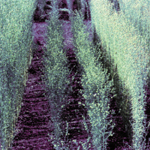
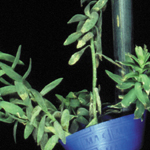
This disease was first reported in Western Canada in 1997. Powdery mildew has spread quickly and its incidence and severity have increased sharply in Manitoba and Saskatchewan.
The causal agent is the fungus Oidium lini, and little is known about the overwintering and host range of this fungus in Western Canada. Early infections may cause severe defoliation of the flax plant and reduce the yield and quality of seed. Some flax varieties are resistant to this disease.
Symptoms:
The symptoms are characterized by a white powdery mass of mycelia that starts as small spots and rapidly spreads to cover the entire leaf surface. Heavily infected leaves dry up, wither and die. Early infections may defoliate the flax plant and reduce the yield and quality of seed.
Control:
The most economical control is through the use of resistant varieties. Early seeding will reduce the impact of this disease on yield losses by avoiding the early infections and buildup of epidemics.
Crinkle
Crinkle is caused by a virus, called oat blue dwarf, that also causes disease in oats, wheat, and barley. Only traces of the disease occur in flax in Western Canada.
Symptoms:
The symptoms are characterized by a conspicuous puckering of leaves, by stunted growth and reduced tillering. Flowering may appear normal but seed production is reduced. Like aster yellows, crinkle is a disease of flax that depends for infection on transmission by the six-spotted leafhopper.
Control:
Seed early to avoid the migrating leafhoppers in mid and late season.
Minor Diseases
In certain localities, occasional fungal diseases may be due to Alternaria linicola causing seedling and stem blight, Colletotrichum lini causing anthracnose of leaves and seedling blight, Phoma exigua causing root rot, and Selenophoma linicola causing dieback. Alternaria and Colletotrichum are seedborne, and may be controlled by fungicidal treatment. Occasionally, Sclerotinia sclerotiorum causes stem mould, stem shredding and breakage in heavily lodged flax.